
At first glance, that might seem like a simple question. But the answer depends on how you define “growth.” Market turnover value has dipped in recent quarters, driven by falling prices and reduced liquidity.
At first glance, that might seem like a simple question. But the answer depends on how you define “growth.” Market turnover value has dipped in recent quarters, driven by falling prices and reduced liquidity. Yet capital inflows into climate infrastructure — including project development, verification systems, and trading platforms — continue to climb. So which signals matter most?
For long-term participants and serious investors, the most relevant and observable indicator is not tokenized asset volume, not media sentiment, and not even capital deployment — it’s carbon credit retirements. Retirements represent the final cancellation of carbon credits, confirming that one ton of CO₂ has been offset. This is the very purpose of a carbon credit: not to trade, but to be permanently removed from circulation to balance real-world emissions.
And by this measure, yes — the carbon market is growing. But not fast enough to match the urgency of the climate crisis.
Retirements Are the True Growth Metric
Retirements have shown encouraging resilience. As the chart above illustrates, carbon credit retirements have remained within a consistent range of 5 to 25 million tons per month since early 2021. While market conditions have fluctuated — from macroeconomic uncertainty to growing scrutiny of credit quality — this core activity signal has held firm.
Seasonal trends are also noteworthy. Each fourth quarter, especially December, has historically seen a retirement spike as corporates close out climate reporting cycles. 2024 is on track to be the third record-setting year in four years for carbon retirements. But to reach that mark, Q4 will need to deliver at least 47 million tons, just shy of the 53 million average seen across recent year-end surges.
While not always visible in headline metrics, the number of companies retiring credits is increasing. Many of these are anonymous or report at a portfolio level, masking the diversity of new entrants. Behind the scenes, hundreds of small and mid-cap firms are testing VCM strategies before publicizing their ESG alignment.
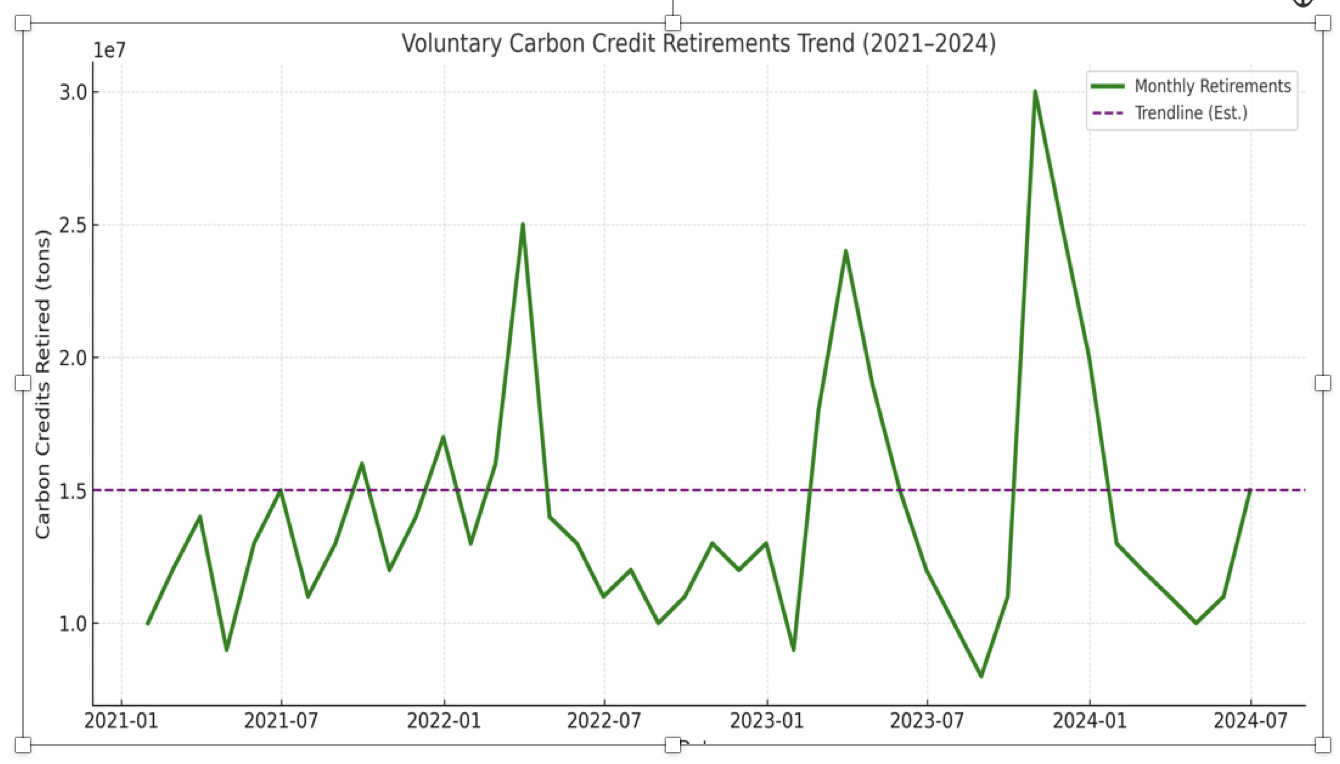
What’s more, retirement activity has remained steady even in a “worst-case” climate market environment — including anti-ESG backlash, geopolitical instability, energy security concerns, and inflation-driven cost pressures. This demonstrates an important truth: existing market participants are not leaving. What’s been delayed is broader adoption — many companies are waiting for clearer regulatory signals, improved credit quality assurance, or sector-level guidance.
But that won’t last. As pressure mounts from mandatory climate disclosures, investor expectations, and impending convergence between voluntary and compliance markets, hesitation will become untenable.
We are approaching a phase of market convergence, where voluntary carbon credits begin to resemble compliance-grade assets. This is already visible in South Africa’s carbon tax and similar regulatory pathways in development across the EU and Southeast Asia. While demand from compliance-linked use is still in its infancy, early pilots suggest growing crossover potential.
Equally significant are upcoming mandatory climate disclosures (e.g., SEC, ISSB, CSRD), which will place carbon offsetting decisions — and credit quality — under sharper investor and auditor scrutiny. In this context, verified, high-integrity retirements will become a strategic advantage, not just a cost center.

If we are to stay on track for the Paris Agreement’s 2°C target, we need the carbon market to grow not incrementally but exponentially. That means going from tens of millions to billions of tons retired annually — a 100x increase by 2030.
The good news? The core mechanics of the market are intact. Participation is growing. Retirements are holding. Infrastructure is maturing. And demand drivers — disclosure rules, policy convergence, and climate risk — are aligning. The next leap forward will come not from speculation, but from real action: permanent, verified retirement of credits.
In short: The carbon market is growing — and it’s about to accelerate.
The article, “Why Carbon Credit Retirements Matter More Than Ever: Market Signals,” directly aligns with Green Carbon Corp’s mission to enhance transparency, integrity, and measurable climate impact within the voluntary carbon market. By emphasizing the accelerating importance of verified carbon credit retirements, the piece reinforces Green Carbon Corp’s commitment to science-backed sustainability solutions that go beyond speculation and contribute to real, permanent emissions reductions. The focus on credible market data, robust infrastructure, and high-quality credit retirement mirrors the company’s strategic aim to empower investors, enterprises, and governments with trusted tools to achieve net-zero goals.
Moreover, the article’s emphasis on market resilience, the evolving regulatory landscape, and the convergence of climate finance policies reflects Green Carbon Corp’s values of innovation, accountability, and leadership in carbon credit trading. As the carbon market matures, Green Carbon Corp continues to position itself as a trusted partner offering precision-calibrated offset portfolios, advanced analytics, and project origination services tailored to the demands of institutional climate finance. This narrative supports the company’s role in driving forward a data-integrity-first carbon ecosystem.