
The carbon credit industry—valued at roughly $2 billion in voluntary trading volume in 2024—is maturing, with more standardized rules and clearer links to corporate net-zero strategies.
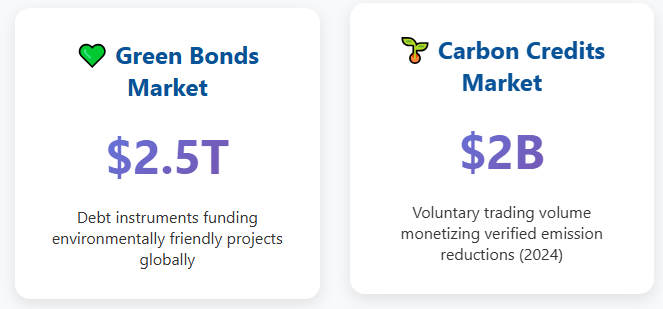
In the rapidly evolving world of environmentally sustainable finance, green bonds and carbon credits are beginning to converge, signaling the emergence of a more integrated climate investment ecosystem. Green bonds—debt instruments designed to fund environmentally friendly projects—have grown into a $2.5 trillion market globally. Meanwhile, the carbon credit industry—valued at roughly $2 billion in voluntary trading volume in 2024—is maturing, with more standardized rules and clearer links to corporate net-zero strategies.
For years, these two markets operated in parallel: green bonds funded projects that reduce emissions, while carbon credits monetized verified emission reductions. But in 2025, a convergence is underway, driven by investor demand for measurable impact, corporate pressure for credible decarbonization, and new regulatory frameworks that connect finance to real-world carbon outcomes.
This convergence represents not just a financial innovation—but a step toward a unified climate finance architecture, where every dollar invested can be traced to a verified ton of carbon reduction.
At their core, both instruments are designed to channel capital toward climate solutions, but they operate differently:
Historically, green bond issuers focused on financial transparency and environmental use-of-proceeds reporting, while carbon project developers focused on quantifying avoided or removed emissions.
Now, the distinction is blurring. As investors demand quantifiable carbon outcomes, some green bond issuers are embedding carbon credit mechanisms into their projects. Similarly, carbon developers are exploring bond-like structures to securitize future carbon revenues.
The logic is simple: why separate the financing of climate projects from their carbon performance when they are intrinsically linked?
Several forces are pushing these two markets closer together:
a. Investor appetite for measurable impact
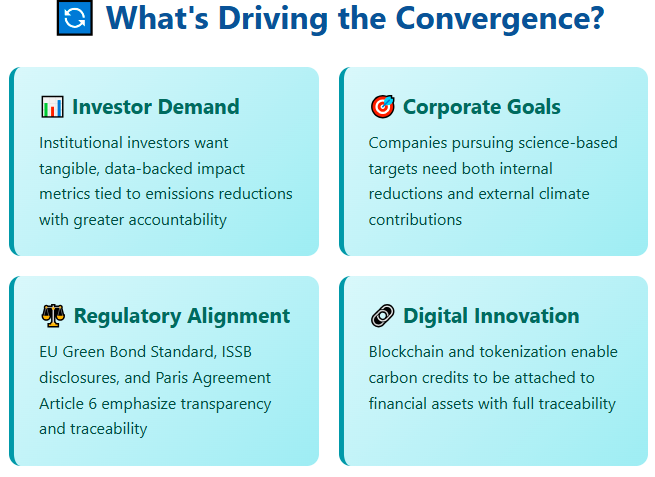
Institutional investors increasingly want tangible, data-backed impact metrics tied to emissions reductions. Green bonds traditionally relied on qualitative reporting—like megawatts of clean energy installed—but adding quantified carbon data (via verified credits) offers greater accountability and comparability.
b. Corporate decarbonization goals
Companies striving for science-based targets are under pressure to show both internal reductions and external climate contributions. Hybrid financial instruments—like “carbon-linked bonds”—allow companies to fund green projects while securing verified credits to meet residual emissions.
c. Regulatory alignment
The EU Green Bond Standard (EUGBS), ISSB sustainability disclosures, and Article 6 of the Paris Agreement are all emphasizing transparency and traceability of carbon outcomes. These frameworks encourage the integration of project-level emissions data into financing instruments, paving the way for carbon-credit-linked bonds.
d. Financial innovation and tokenization
Digital platforms and blockchain technology now enable carbon credits to be tokenized and attached to financial assets, ensuring traceability, preventing double counting, and improving liquidity.
The result: a new hybrid asset class that merges the stable returns of fixed income with the dynamic value of verified carbon performance.
While still nascent, several real-world examples illustrate how this convergence is unfolding:
a. Société Générale’s carbon-linked bond (2024)
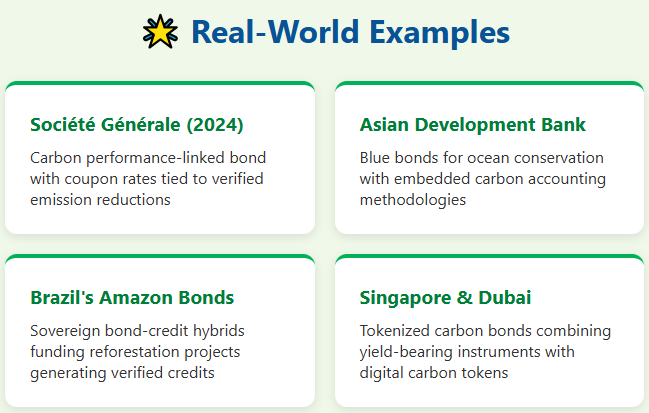
In partnership with a renewable developer, the French bank issued a carbon performance-linked bond where coupon rates were tied to verified emission reductions. The more carbon credits the project generated, the lower the cost of capital—a direct incentive to maximize climate impact.
b. The Asian Development Bank’s blue bonds and carbon offset integration
ADB’s “blue bond” program finances ocean conservation and sustainable fisheries, but recent issuances include embedded carbon accounting methodologies to quantify avoided emissions, creating potential for future carbon credit monetization alongside debt servicing.
c. Brazil’s Amazon reforestation bonds
Emerging markets like Brazil are exploring sovereign-level bond-credit hybrids, where proceeds fund reforestation projects that generate credits under the ART-TREES or Verra standards. This dual structure attracts both climate-conscious investors and governments seeking verified climate results.
d. Tokenized carbon bonds in Singapore and Dubai
In digital finance hubs, blockchain-enabled carbon bonds allow investors to hold both yield-bearing instruments and digital carbon tokens within a single investment. This innovation could revolutionize how carbon-linked debt is issued and traded globally.
The merging of these instruments offers several advantages for issuers, investors, and the planet alike.
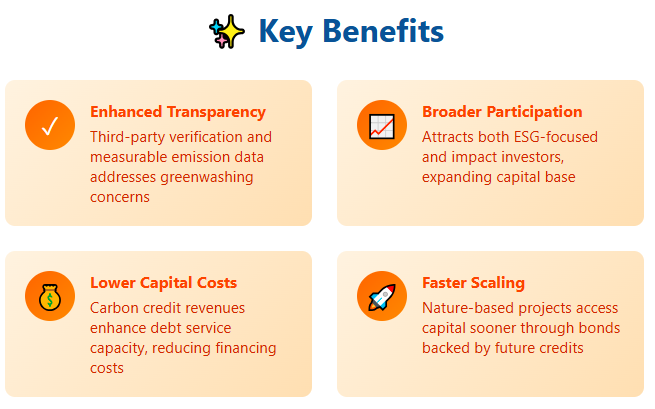
a. Enhanced transparency and credibility
Carbon credits bring third-party verification and measurable emission data to green bonds, addressing long-standing concerns about greenwashing in sustainable finance.
b. Broader investor participation
Carbon-linked bonds attract both ESG-focused institutional investors and impact investors seeking exposure to verifiable carbon outcomes. This expands the capital base for climate solutions.
c. Lower cost of capital for high-impact projects
Projects that can monetize carbon reductions through verified credits can use those revenues to enhance debt service capacity, effectively lowering financing costs.
d. Faster scaling of carbon removal and nature-based projects
Nature-based projects often struggle to secure early-stage financing. By structuring green bonds backed by future carbon credit revenues, developers can access capital sooner and scale faster.
In short, this convergence could unlock billions in new funding for the climate transition by aligning environmental and financial incentives.
Despite the promise, integrating carbon credits into financial markets poses challenges that must be carefully managed.
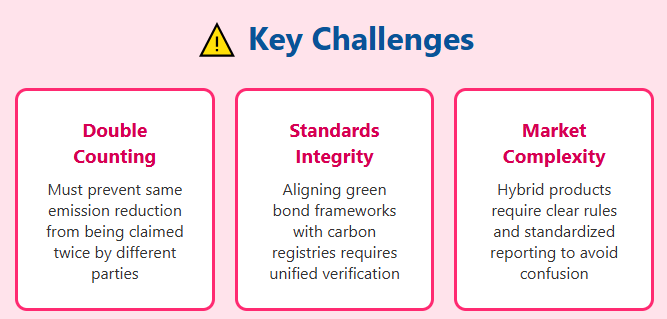
a. Avoiding double counting
If a project issues both a bond and a carbon credit, regulators must ensure the same emission reduction isn’t claimed twice—once by the investor and again by the credit purchaser. Article 6 accounting rules under the Paris Agreement are designed to mitigate this, but harmonization remains a work in progress.
b. Maintaining integrity across standards
While green bonds follow frameworks like ICMA’s Green Bond Principles, carbon credits rely on registries such as Verra, Gold Standard, and ART. Integrating these systems requires alignment in verification timelines, methodologies, and audit standards.
c. Market complexity
Hybrid products combine two already-complex domains—finance and carbon accounting. Without clear rules and standardized reporting, investors could face confusion or risk mispricing the environmental benefit.
To succeed, this convergence will require new layers of governance, audit transparency, and data interoperability between financial and carbon market infrastructures.
Over the next two years, this convergence will likely accelerate as carbon markets mature and investors seek deeper ESG integration.
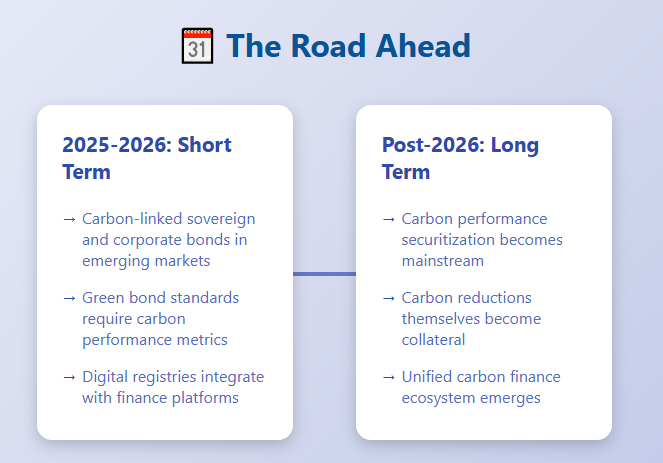
Short-term outlook (2025–2026)
Long-term vision (post-2026)
By the late 2020s, we could see carbon performance securitization become mainstream—where carbon reductions themselves are collateralized, allowing investors to directly fund verified decarbonization outcomes.
This would mark a transformation from today’s fragmented system into a cohesive carbon finance architecture, in which green bonds, carbon credits, and climate-linked derivatives all operate within one traceable, data-driven ecosystem.
The convergence of green bonds and carbon credits represents a pivotal evolution in climate finance—one that merges the discipline of traditional capital markets with the quantifiable impact of carbon accounting.
This integration is not merely a financial innovation—it’s a structural shift that could redefine how capital flows toward the planet’s most pressing challenge. By linking financing to verified climate outcomes, investors are no longer just funding sustainability—they’re owning a measurable piece of the transition to net zero.
As markets evolve, the future of sustainable finance may well be carbon-accountable by design—a world where every dollar of green investment is tied directly to a ton of carbon saved.
A world where every dollar of green investment is tied directly to a verified ton of carbon saved-creating a unified, carbon-accountable climate finance architecture where finance and environmental impact finally meet.