
In 2025, tools that once seemed futuristic (autonomous report generation, real-time policy intelligence, predictive price modeling) are now being adopted as standard in serious climate finance firms, consultancies, and registries.
Carbon credit offsets are incredibly ubiquitous in 2025- yet despite wide availability, consumer uptake is uneven. Some customers click to offset a flight or a purchase without thinking. Others refuse outright, suspicious of greenwashing or unconvinced the offsets work. Understanding the psychology behind those choices is essential for brands, NGOs, and platforms that want offsets to be credible, used, and effective.
Below we unpack the behavioral drivers that push people toward (or away from) buying offsets, show how messaging and product design change outcomes, and give SEO-optimised keyword guidance for publishers and marketers in 2025.
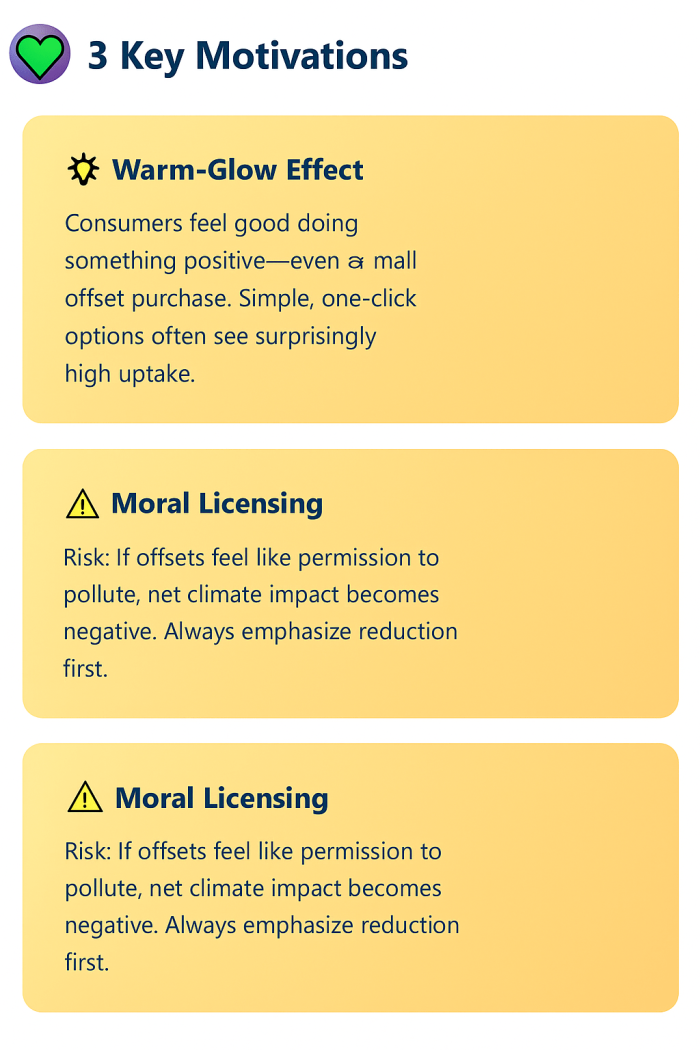
Academics studying voluntary environmental behavior consistently find three psychological motives behind offset purchases.
First, the “warm-glow” effect: people feel good when they do a prosocial act—even a small one like buying an offset. Research shows consumers sometimes buy offsets less because of detailed impact evaluation and more to feel they did something positive. This explains why simple, low-friction options (one-click offsets) often have surprisingly high uptake.
Second, social signaling matters. People buy offsets when they expect others will approve (or when they can signal virtue publicly). Social proof—badges, receipts, or social shares—can nudge more purchases. BCG and other consultancies have documented how consumer-facing offset products succeed when paired with clear, shareable credentials.
Third, watch for moral licensing. If customers believe buying offsets frees them to keep polluting, the net climate impact can be negative. That’s why behavioral economists caution companies against presenting offsets as a substitute for emissions reductions. Studies underline that repeated exposure improves sensitivity, but single purchases are often driven by feelings rather than deep impact cognition.
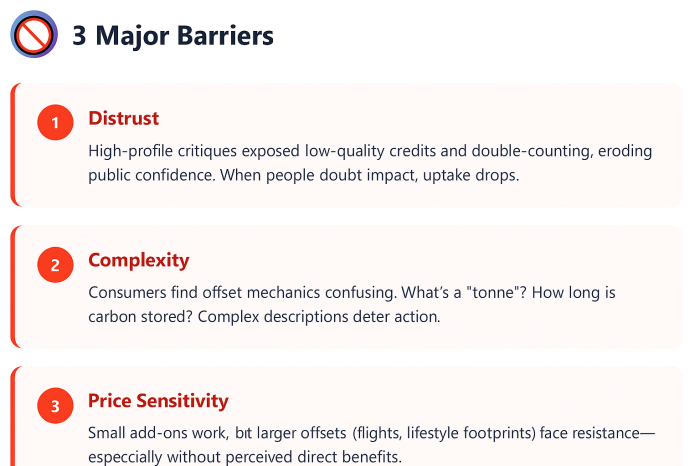
Why do many consumers not buy offsets? Three barriers stand out.
Distrust is the biggest. High-profile critiques and investigations have exposed low-quality credits, double-counting, and shaky additionality—eroding public confidence. Peer-reviewed analyses and media investigations have found worrying percentages of low-integrity credits in circulation, which fuels consumer skepticism. When people doubt whether their money actually removes emissions, uptake drops.
Perceived complexity is the second barrier. Consumers often find offset mechanics confusing: What does “one tonne” mean? How long will the carbon be stored? Complex descriptions deter action; clear, simple options win.
Price sensitivity is the third. While many consumers will accept small add-ons, larger offsets (e.g., for flights or entire lifestyle footprints) face resistance—especially if buyers don’t perceive direct benefits.
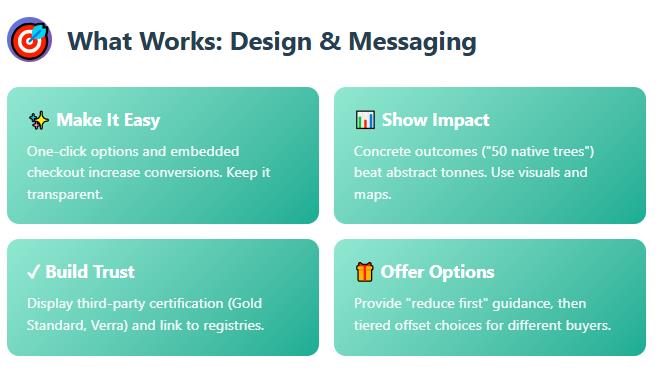
Behavioral science gives practical tactics that increase purchase rates while protecting integrity.
Make it easy. One-click options, embedded offsets in checkout, or pre-selected (but opt-out) choices increase conversions. But opt-out must be used ethically and transparently to avoid backlash.
Show impact, not just price. People respond better to concrete, localized outcomes (“this funds 50 native trees in your state”) than abstract tons of CO₂. Visuals-before/after photos, project maps, and short videos-help.
Use trusted verification and clear labeling. Displaying third-party certification (Gold Standard, Verra, ICVCM alignment) and linking to registry records reduces distrust. Recent market reforms and integrity pushes make third-party seals even more important in 2025.
Offer options and bundling. Provide “reduce first” guidance plus an offset choice. Offer tiers—low-cost nature-based credits for small footprints, premium removal credits for permanence-oriented buyers. Research shows repeated exposure and tiered choices increase long-term engagement.
Brands must avoid overclaiming. The most effective messaging:
When companies fail on transparency, consumer trust evaporates quickly—sometimes faster than it was built. Recent corporate retreats from offset claims illustrate that reputational risk is real and rising.
Not all consumers are alike. Effective strategies tailor offers by segment:
Surveys indicate younger consumers may feel skeptical yet willing to act if transparency and community benefits are clear—so messaging across channels (social, email, checkout) should be aligned and repetitive.
Final checklist for brands & platforms
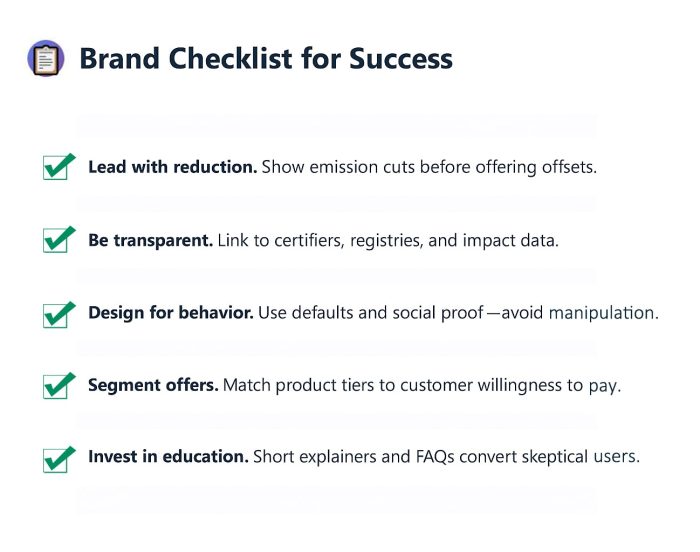
Consumers buy carbon offsets for emotional, social, and practical reasons—and they avoid them when trust and clarity are missing. In 2025, with scrutiny of credit quality rising and regulation tightening, the brands that succeed will be those who combine behavioral design with rigorous transparency. That means making offsets easy to buy, truthful to describe, and anchored to credible, verifiable climate impact.